Building a Data Program Your Members Will Champion
Industry data exchange programs represent one of the most compelling ways for associations to extend their value to members. A deliberate, member-driven process determines whether they take hold.
For many associations, the conversation about a member data program starts with a question that is harder to answer than it looks: where do we begin? The concept is compelling: pooling industry data across a membership to produce aggregated, anonymized benchmarks and insights no individual member could generate alone. The business case is straightforward. But the path from an idea to a program that members actively engage in, and champion, is less obvious. Execution is where many promising initiatives lose momentum.
What follows below is a look at how associations approach this opportunity through a structured, collaborative process; one designed to move at the pace of member consensus rather than ahead of it.
WHY THE DEVELOPMENT PROCESS SHAPES THE OUTCOME
A data exchange is, at its core, a program where member companies contribute agreed-upon industry metrics, and in return, receive aggregated, anonymized benchmarks they could not generate on their own. Associations and their members define what gets measured, how it is reported, and what protections are in place before a single number is submitted. The more members participate, the richer and more useful those benchmarks become. Programs that earn sustained participation share a common thread: members were part of building them.
That means the most consequential work happens before any data is collected. Decisions about what to measure, how to define terms, what the output looks like, and what participation requires all land differently when members have shaped them versus when they are handed down. The development process is where programs earn credibility and buy-in that carry them forward.
The conversations that happen on the way to launching a data program often surface as much value as the program itself, shared challenges, emerging trends, and areas of member need that were not visible before
This is also what makes the association the right home for a program like this. The access, the neutrality, and the existing relationships create conditions for candid engagement that no other entity can replicate. The data exchange becomes an extension of what the association already does well.
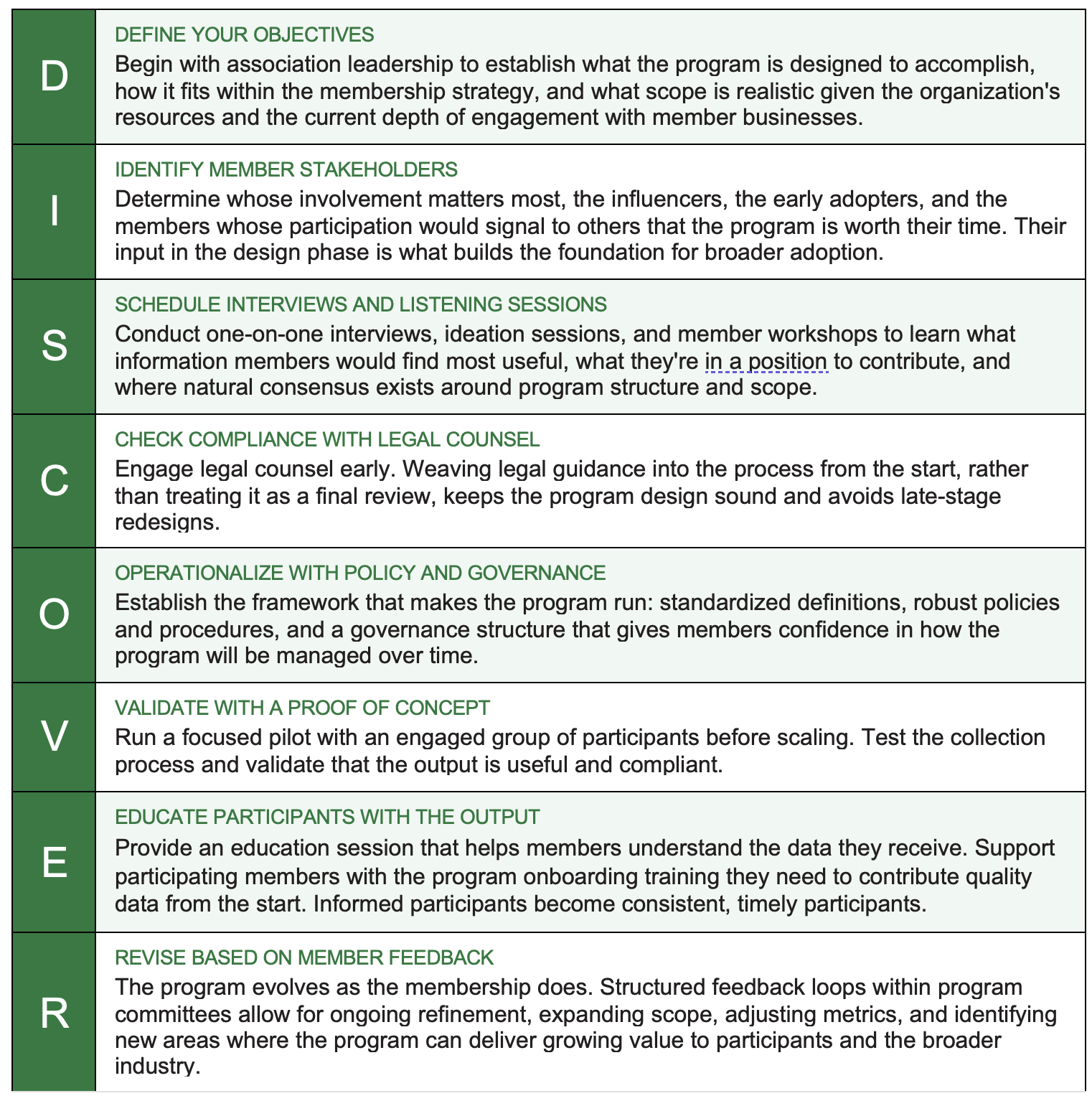
HAI’S PROPRIETARY DISCOVER FRAMEWORK: FROM CONCEPT TO LIVING PROGRAM
DISCOVER is a phased process that guides associations through the full arc of program development, from aligning on objectives through ongoing refinement. Each phase is designed to be collaborative and responsive to what the previous one surfaces.
WORKING WITH A PARTNER WHO HAS BEEN HERE BEFORE
A successful and compliant data exchange program spans member needs analysis, platform development, governance design, legal compliance checkpoints, data quality, member facilitation, and ongoing operations. Associations that have built strong programs rarely navigate all that in isolation, and they don’t need to. An experienced partner can compress the learning curve, identify key steps to take, and help engage members in the co-creation process.
What that partnership looks like in practice is a knowledgeable collaborator who learns and adapts to your membership, your industry, and your organization's pace and culture. Every decision about what to measure, how to define it, and what the program produces is determined by the association. The expertise a partner brings is in service of that, not a substitute for it.
A member-driven data exchange program can compound over time, growing value, deepening engagement, and strengthening the industry.
Learn more about how HAI supports associations through this process at hargrovedata.com/cma-2026.